Thursday, November 18, 2010

Garden update

Quick note to indicate the status of the garden.. just documenting how long a kitchen type garden can be kept going this year, and wanna keep the pics going as long as I can, tedious though it is on some days, so I can look back next year and actually *see* and not just think.. "well, I think it was OK tup to November-ish.." you know what I mean? So, bear with me.. we've gotta be in the home stretch now.. this thing can't hold together *that* much longer, right? So, on with the documentation:

Just an overview of the beds.. chickens in sight!

Too much empty space. Should have planned further ahead!

These are the lettuce transplants from the planter box from earlier..

Arugula and Spinach in sight. Barely...

The peas, however, are hit!
Like I said, just an update.. I see the Amaryllis is doing awesome over there on the windowsill, however. I'll have to take some pics of that tomorrow and get those up and online. Looks like three big flowers just popped up overnight. Not opened yet, but emerging.. stay tuned!

Tuesday, November 16, 2010

Amaryllis and eHLT..

The Amaryllis is coming along pretty well.. on the verge of popping out and actually looking like a flower any day now. Check it out:

It's about 2' tall now..


Otherwise, here's some pics of the grounding ring idea I came up with, with a bit of help from my engineering team ;), to ground the electric element to the keg and thus the ground. Also, a pic or two of the JB Weld attachment of the electrical extension box to the side of the keg. This stuff is *way* stronger than I had any idea it would be. To take this off now would require a hammer and some finish work with a grinder to get the JB Weld off. It's serious stuff!

Simple. A metal flat plate with a big hole in it for the element to pass through and ground on.. 

Assembled.. 

And bottom view, with gasket on there.. 

I put a bit of JB Weld on the outside of the box, but..

..most of it is on the inside. 
Next, I did a little electrical work on the inside of the box, including fabricating up all the wires and jumpers and putting the box all together. Check out the mostly finished project:

Not so complicated after all.. 

All buttoned up. ON is UP!

Add caption
Haven't run a powered on test yet, because I discovered a small leak around the gasket yesterday when I filled it up with water.. seems there's some seepage around the main gasket that wasn't there before I installed the grounding ring thing. I may have to rethink that a bit.. I'll report back with a solution later.

Friday, November 12, 2010

Horseradish..

Pulled up the horseradish yesterday.. this is what I got:


Sort of an ugly bugger. I thought it was gonna be more like carrots, with each root sorta more carrot shaped with a tuber going straight down.. but it's more hop rhizome like than that, with just a big tangled mass of roots all over the place. There's also going to be no problem with next years crop, because this thing pretty much infested the side herb garden area with little rootlets. Awesome. Now I just gotta go get some more llama manure and make that soil area more hospitable. It's really sandy and terrible stuff for growing, really.

Anyway, a little more hosing of off this tangled mass found this stuff underneath..


That's the biggest single chunk of root that I found in there. about the same size as that piece my dad brought me from his friend somewhere in America that time.. so I remembered how to process this stuff into the horseradish sauce that we all know and love (well, those of us with taste, I should say..). Easy stuff.. just dice it up into chunks about an inch long or so after you peel the outside layer of rough skin off the thing, and then zing it for a few seconds or so in your food processor until it's almost a paste. Then, give it the sniff test and keep an eye on it for about 30 seconds or less till the stuff has reached the level of pungency you want, and then douse it with vinegar and stir, to cancel the reaction and lock the flavor into place. The trick with vinegar is, once you dice and shred the root into small bits, the exposure to the air is what activates the enzymes inside to break down this stuff inside the root called 'sinigrin'. When this happens, the byproduct of the breakdown process is isothiocyanate, which is an harsh and mean as the name implies. The longer you leave the shredded bits exposed to the air, the more powerful the stuff becomes. By adding vinegar, a mild acid, you quench the process and stop it in it's tracks right where it is.. so, home made horseradish is very flexible stuff.. as it can be as mild or mean as you want it to be. Frickin' awesome!

When I was all done, speeded up in part to my horseradish processing associate Jody, we ended up with this:


Two jars of heaven. Again, awesome! Next year, I hope to have much more. There is really nothing on earth easier than horseradish, I think.. great stuff and easy to do. Just don't plant it anywhere near your regular garden.. it get's everywhere.

Wednesday, November 10, 2010

Chicken moltin'...

Got me a chicken that's a moltin'.. there's feathers all over the yard. One of the Barred Rocks, the bigger one, is sheddin' all over the place and she really looks like hell now. The kids think it's kinda funny though, and they're collectin' the big feathers from around the yard and keepin' them in a jar.. presumably to re-create the whole bird eventually? I can't imagine why else they'd do that. Check it out.. snapped a few pics this morning of the poor, fashion-less bird:


Yeah. Gonna get chilly, I suspect..

Tuesday, November 9, 2010

Big Brew at Don's Dad's house...

Just wanted to share a few pics of the Big Brew we had at Don's Dad's place, sponsored of course, by Don's Dad & Mom as well as Don himself. Great time was had by all. This event also marked the debut of two brand spankin' new brewing rigs, Don and Geoff's metallic monster and Jeremiah's half electric, half propane Frankenbrewery. Here's a few pics of the event and attendees to document the fact that the damn thing happened on Saturday, November 6th, 2010...

Jeremiah with his newest brewery creation.. eHLT!

Timmay and Eric, spargin'.. 

Geoff and Don's new single spine gravity tree..

Launch controler..

Mike Hill, doing something mysterious..

Will and Alex, goofing around.

Jody, rockin' the Top Tier. Classy..

The fruits of Jer's and my brew day.. 5 gallons each of Am. Amber. The newest revision..

Jer took home all of the brewer spent grain that day to feed to some local cows. Damn, we're green!
So, yeah. Resounding success. And I think we may have even inspired some other non-brewers to maybe look into the process. Seems everyone had a pretty good time..

Thursday, November 4, 2010

Wicked HLT graphs!

Did something funny today and jury-rigged up my HLT.. no switch, no safety covers, just plugged it straight into the wall and let it rip. Talk about yer' reckless!


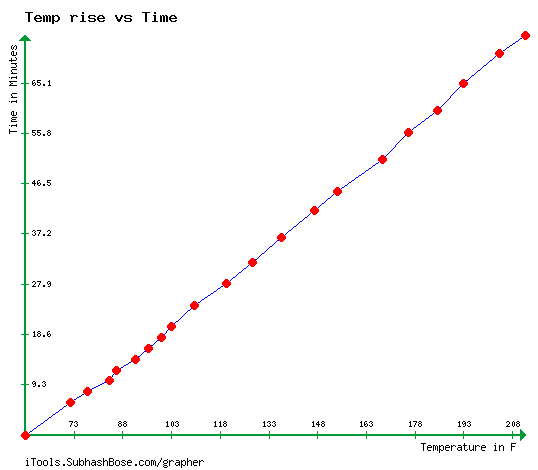
Did this with a mostly typical strike water sized volume of water.. 10 gallons. Actually, most strike water volumes for the beers I brew are more like 8.0 to 9.5 gallons for the initial batch of strike water.. and somewhere generally in that same ballpark for the sparge water after the mash. But I figured, let's go large, right? So, I filled it up with cold water from the outdoor faucet which leveled out at 10 gallons of 58 degree water. Then, I plugged in the element and started writing down numbers and times.. I started out doing 2 minute intervals, but I got bored of that pretty quick, and moved to three minutes.. then I missed one along the way and moved to four minutes. It seemed to be doing a pretty straight temp rise anyway, based on the rough numbers in my head that I was seeing, so, whatever.. I then whipped out a handy online graphing program and plotted the 21 data points I gathered and.. lo and behold! This is what I got:


Damn straight, that's a pretty straight line. What the chart is failing to show, for some reason, is the last two points on either end. It ended up boiling at the 74 minute mark, and that's off the chart up there. The main thing to look at, however, is that I never heat stone cold water. I always heat water from the hot water tap that comes out at like, 160 degrees or so.. by the time I get it into the cold HLT and all filled up, it settles in at around the 140 F range, and we heat from there. I can't recall ever measuring exactly how long it takes propane to heat water from 140 to a typical strike water temp like 162 or so, but I'd guess somewhere in the 25-40 minute range. We're usually milling grain and shooting the bull and drinking coffee at this stage of the game anyway, so it doesn't matter much.. but according to this chart, this element will heat from about 140 to around 162 in roughly 10-12 minutes. It's about a 10 degree rise in temp every 4 minutes or so, give or take.

Oh, snap! That's fast. And this is with a 3500w element. You can imagine how quick Jeremiah's is with a 5500w element. That thing is a monster. I think 3500 is enough for me, though. :)

Sunday, October 31, 2010

Brewery mods for electricity..

Just got back from the welder shop where I picked up my newly modified kettle that now has the big stainless steel nut welded into the side for the electric element to attach on to. Check the pics for some detail.


Interior view of the element coming into the keg..

Nice welding job, done by Accurate Welding of Barkhamsted. 
The next step is to gather up the appropriate parts to make the connections from the 220v wall outlet to the element, which includes the switch, the box to hold all the parts, the wire holder thingy, and the plug itself. I've already got 16 feet or so of 14 gauge three strand wire, so it's just the little pieces I've got to gather up now. I think a trip down to Lowes should pretty much do the trick. I've been talking to my electrician friend Dave E. and my other ingenious pal Jeremiah to work out the details of all these connections and how to make it safe and workable, and I think I have a plan in mind. Stay tuned for that..